1
/
of
8
Kuretake
Kuretake Ink-Café Fountain Pen Ink - Meiji no Iro (20ml)
Kuretake Ink-Café Fountain Pen Ink - Meiji no Iro (20ml)
Regular price
$26.95 CAD
Regular price
Sale price
$26.95 CAD
Shipping calculated at checkout.
Quantity
Couldn't load pickup availability
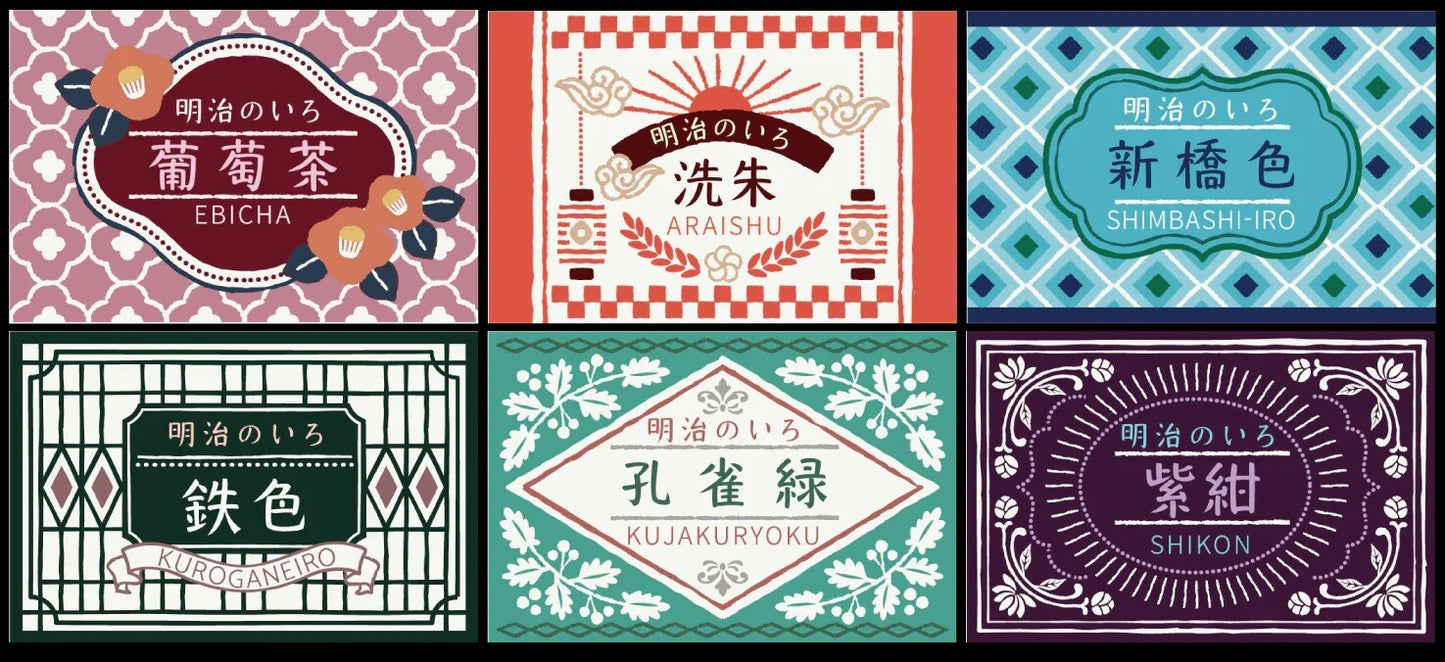
Meiji no Iro (Colors of the Meiji Era) Fountain Pen Ink
"Meiji no Iro" is a collection of beautiful color inks inspired by the popular shades that defined Japan's transformative Meiji Era. Each color carries its own historical background, allowing you to enjoy a piece of history with every stroke. These inks are perfectly compatible with fountain pens, glass pens, dip pens, and Kuretake's "Karappo-pen" (DIY empty pens).
The Stories Behind the Colors
- Ebi-cha (Maroon / Reddish-Brown)
During the Meiji era, purple was reserved as a noble color for the aristocracy. Because pure purple was considered too formal for common use, "Ebi-cha"—a dark red with a hint of purple—became its popular alternative. This color exploded in popularity with the boom of female student culture in Meiji-era schools, where it was heavily used for women's traditional school hakama. - Arai-shu (Washed Vermilion)
In the late Meiji period, a movement to cherish traditional Japanese culture sparked the creation of new classic tones. One of these was "Arai-shu," a bright, fresh vermilion that looks beautifully diluted or washed out to a softer, gentler shade. - Shimbashi-iro (Shimbashi Turquoise / Cyan)
The introduction of chemical dyes in the late Meiji period birthed entirely new hues. This bright, vivid blue-green was considered highly fashionable and Westernized ("haikara"). It became a massive trend, especially favored by the geishas of the Shimbashi district, and was also known by the alias "Komparu-iro." - Kurogane-iro (Iron Dark Green)
A trend that lasted from the mid-Meiji period into the Taisho era. It is characterized by a dark, muted blue-green with deep blue undertones. This color was heavily used for the aprons worn by shop managers ("banto") and clerks. In traditional naming, gold was kogane, silver was shirogane, copper was akagane, and iron was called kurogane. - Kujaku-ryoku (Peacock Green)
Introduced from the West during the Meiji era, this is a vibrant blue-green that mimics the stunning feathers of a peacock. While peacocks had been adored in Japan since ancient times and became widely known to the public in the Edo period, it is considered a mystery that a color named after the peacock was never actually created until the Meiji era. - Shikon (Deep Violet)
The Meiji era is often referred to as the "Age of Purple," as women's clothing heavily inherited the sophisticated Edo-period aesthetics of wisteria (fujiiro) and purple. "Shikon" (Deep Violet) emerged as a prominent trend-setting color through and after the Meiji period.
Product Specifications
- Brand: Kuretake (Ink-Café series)
- Product Weight: 111g
Delivery & store pickup
Shipping options and rates are shown at checkout. Free store pickup is available at 1200 St Laurent Blvd, Ottawa; most orders are ready within 24 hours.
Simple returns
Returns are handled according to our policy. Please keep the item unused and in its original packaging. Read the policy.